


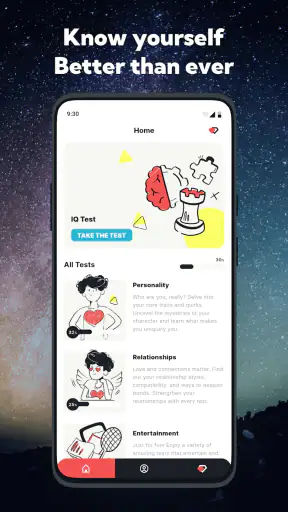
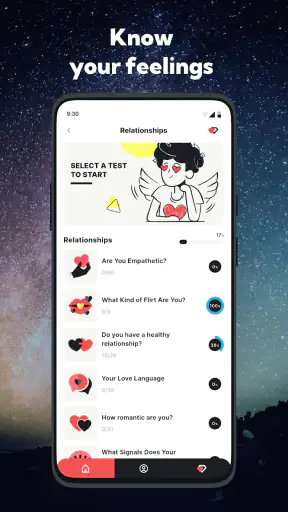
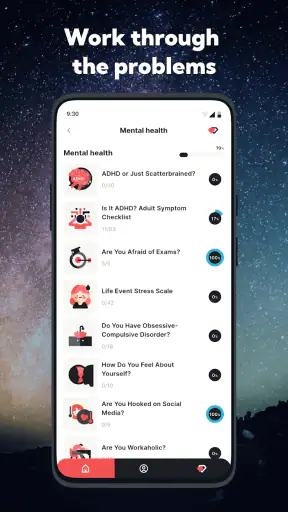
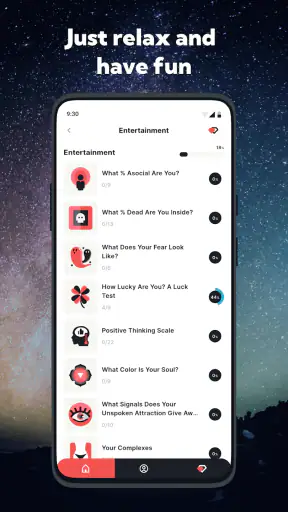
I tried Personality Tests & IQ Test as a quick educational app for the moments when you want to reflect on your habits, preferences, or reasoning style without committing to a long course. Developed by DevSect, it sits somewhere between a casual quiz collection and a self-reflection tool. The central appeal is simple: answer questions, receive an interpretation, and use the result as a starting point for thinking about yourself.
That simplicity is also the key to using it well. I would not treat a result as a diagnosis, a professional assessment, or a fixed description of who you are. The app is much more useful when I read its outcomes as prompts for discussion and curiosity. Used that way, it can fit into a quiet evening alone, a conversation with friends, or a shared household device where different people take turns exploring the tests.
How the app works in everyday use
The app belongs to the education category, although its tone is lighter than a traditional learning platform. Its store summary focuses on discovering possible psychological problems through a psychological test, while the short description presents it as a collection of personality tests. That combination makes the wording important: a quiz can highlight patterns in answers, but it cannot establish a mental-health condition.
My first impression was that the experience is designed for immediate participation rather than extended study. You open it, choose a test, and respond to a sequence of questions. This makes it easy to use when you have only a few spare minutes. It also means the value depends heavily on how carefully you answer. Rushing through choices just to see the result turns the exercise into entertainment rather than useful self-reflection.
The most practical way to approach a test is to answer for your usual behavior, not for the person you would like to become. I found that this distinction matters especially with personality questions. Someone may select the socially confident answer because it sounds desirable, even though their everyday experience is different. If you want a more meaningful result, pause when an answer feels flattering and ask whether it describes your normal week.
The IQ-oriented side should be handled with the same caution. A short mobile quiz cannot represent every part of intelligence, and performance can change with concentration, familiarity with puzzles, language, fatigue, or the environment around you. I would use the result as a snapshot of that session, not as a label for academic or professional ability.
A realistic shared-device scenario
Imagine a household tablet on the kitchen table. One person wants to try a personality quiz after dinner, while another is curious about the IQ-style questions. This app can work well in that situation because the activity is easy to understand and does not require a group to learn complicated rules. Each person can take a turn, discuss the outcome, and move on to another activity.
The important boundary is that a shared device is not the same thing as separate private accounts. I would not assume that every result is automatically isolated from the next person, or that one family member’s answers are protected from casual viewing. Before handing the device to someone else, I would close the current screen and avoid leaving personal responses visible. If privacy matters, I would prefer using the app individually on a personal device rather than treating a communal tablet as a private journal.
This is also where household coordination helps. Agree in advance that results are not used to tease, rank, or diagnose one another. A teenager may answer differently when a parent is watching, and a partner may not want to explain every response. The best shared use is voluntary: invite conversation, but do not demand disclosure.
Setting boundaries before anyone starts
Because the app is free to download, it is easy to pass around without much planning. It does include in-app purchases ranging from $3.99 to $99.99 per item, so I would check the device’s purchase arrangements before allowing unsupervised use, especially on a shared phone or tablet. The free entry point does not mean every part of the experience should be treated as cost-free by default.
I would also establish a simple rule for children: a result is something to discuss, not something to obey. If a quiz suggests that someone is anxious, impulsive, introverted, or unusually gifted, that wording should not become a household identity. Children are still developing, and even adults change depending on circumstances. A quiz result can open a conversation, but it should never replace a parent’s attention, a teacher’s observation, or professional support.
Another useful boundary is time. These tests can become repetitive if everyone keeps retaking them in search of a more flattering outcome. If the purpose is reflection, one thoughtful attempt is usually more useful than several rushed attempts. For an IQ-style test, repeating questions immediately can also make the outcome less informative because memory and familiarity influence the second try.
I would keep a small note outside the app if the household wants to compare experiences over time. Write down the date, the test taken, and how the person felt while answering. This does not turn the app into a scientific record, but it helps show how context affects results. Someone completing a quiz after a stressful day may receive a very different impression from someone answering after a good night’s sleep.
Coordinating results without turning them into labels
The strongest shared-use case is conversation. After a result appears, ask which parts felt familiar and which did not. That question is more valuable than asking whether the result is “right.” It gives the person room to disagree and encourages critical thinking about the test itself.
For couples or roommates, I would avoid comparing scores as if they were a contest. Personality differences can be useful when discussing how people communicate, organize chores, or handle plans, but a quiz should not decide who is more reasonable. A better exercise is to connect a result to a concrete situation: “When plans change suddenly, is this how you usually react?” That turns a vague label into a practical conversation.
Parents can use the same approach with older children, provided the child wants to participate. If a result raises a concern, ask about real-life experiences rather than interrogating the answer. The app may provide a prompt, but the household still needs to listen to the person behind the response.
There is also a useful distinction between private and group tests. A person may enjoy showing a light personality outcome while keeping more sensitive answers private. I would never make sharing a condition of participation. On a shared device, this means giving each user time alone, clearing the screen before passing it on, and avoiding screenshots or saved notes that expose someone else’s responses.
Age, trust, and the meaning of a result
The content rating is Everyone, which makes the app broadly approachable from an age-label perspective. That does not mean every question will have the same meaning for every age group. A child, teenager, and adult may interpret questions about work, relationships, stress, or responsibility through very different experiences.
For younger users, I would sit nearby without answering for them. Helping with unfamiliar vocabulary is reasonable; steering the response toward a preferred result is not. If a question seems confusing or uncomfortable, skipping the test is better than forcing an answer. The app should remain an optional activity, not a household assessment.
Trust matters even more when the store summary uses psychological language. If a result mentions a possible problem, do not present it as proof. Look for persistent real-world signs and, when appropriate, speak with a qualified professional. The app can help someone find words for a feeling, but it cannot evaluate a person’s history, environment, medical background, or safety.
I also recommend explaining this to children in plain language: “This is a quiz that gives an idea, not a doctor.” That sentence prevents a surprising amount of confusion. It also models healthy skepticism, which is valuable for any app that turns complicated human behavior into short answers and a final interpretation.
What makes it useful beyond a casual quiz
The first non-obvious strength is its usefulness as a conversation starter when the household struggles to discuss habits directly. A result gives people something concrete to react to, even if they disagree with it. Used carefully, that can make it easier to talk about concentration, social energy, decision-making, or stress without beginning with an accusation.
The second is the opportunity to compare context rather than simply compare people. Try the same kind of test at different points in the week, then discuss what changed in your mood and focus. I would not interpret the differences as precise measurements, but they can reveal that a result is influenced by circumstances. That is a healthier lesson than assuming a single score defines someone.
The third is using the app as a prompt for better questions. After a personality result, ask what behavior the person wants to understand more clearly. After an IQ-style result, ask which question types felt difficult and why. This shifts attention from the label to a skill or habit that can actually be explored.
There is a trade-off here. The app’s quick format makes it approachable, but quick formats necessarily simplify. Someone looking for validated psychological testing, detailed explanations of methodology, progress tracking, or structured lessons will probably find a specialist service or a course more appropriate. Someone who wants a relaxed introduction to self-reflection may appreciate the lighter approach.
Technical expectations and value
The app supports devices running Android 7.0 or later, and the current version is 2.07. That gives it a reasonably broad reach for people using older Android hardware, although the experience will still depend on the device and operating system. I would update it through the normal app store process and check the screen before sharing a device with another person.
DevSect has attracted a sizable audience: the app has passed one million installs, with an average rating of 4.2 from around twenty-four thousand ratings and roughly two thousand four hundred written reviews. Those figures suggest that many people find the format approachable, but they do not prove that the interpretations are clinically accurate. Popularity is a useful sign of interest, not a substitute for evidence.
The free price makes trying it low-risk at the start, while the in-app purchase range means I would pay attention whenever the app presents an upgrade or additional item. For a household, decide whether paid content is appropriate before several people begin exploring it. This is particularly important when a child uses an adult’s device or payment setup.
I would also avoid judging the app solely by whether one result feels personally accurate. Quizzes are sensitive to wording and mood. A result that feels vague may still prompt a worthwhile discussion, while a result that feels uncannily accurate may encourage overconfidence. The right question is not “Did it read my mind?” but “Did this help me think more clearly about a real part of my life?”
Who should use it, and who should choose something else
I think it suits curious adults, older children with guidance, students who enjoy informal self-reflection, and households looking for a short shared activity. It is especially convenient when you want a starting point for discussing personality or reasoning without downloading a full learning platform.
I would skip it if you need a formal diagnosis, a professional IQ assessment, or advice about a serious mental-health concern. It is also not the right choice for anyone who feels pressured by scores or tends to treat app results as permanent truths. In those cases, a qualified professional or a more structured educational resource would be safer and more useful.
For private journaling, a notes app may be better because it gives you control over the questions and lets you describe nuance in your own words. For validated testing, look for an assessment designed and interpreted by qualified specialists. For family bonding, a conversation game may be preferable if the goal is laughter rather than psychological interpretation.
My practical recommendation is to use this app in short sessions, answer honestly, read results skeptically, and keep sensitive responses private. Do not let a shared-device setup blur the line between participation and permission. Every person should choose whether to take a test and whether to discuss the outcome.
My household verdict
After using Personality Tests & IQ Test, I see it as a friendly introduction to quizzes about personality and reasoning, not as an authority on the mind. Its free entry point, Everyone rating, broad Android compatibility, and simple format make it easy to try in a household, but the same simplicity calls for clear boundaries around purchases, privacy, and interpretation.
I would recommend it to a friend who wants a quick conversation starter or a little personal reflection. I would not recommend using it to settle arguments, judge a child, select a career, or decide whether someone has a psychological problem. The best results come when the app stays in its proper role: a prompt that helps people ask better questions about themselves.
In a shared home, that distinction is the whole experience. Give each person control over their answers, close the screen before passing the device around, and treat every outcome as provisional. With those habits, DevSect’s app can be a pleasant educational diversion and an occasional way to start meaningful conversations. Without them, its labels can create more certainty than the short quiz really deserves.


